Is America in Revival?
In our own congregation over the last 16 months, Trinity has experienced several signs of healthy growth:
Attendance at our modern worship service (9:00 am) has experienced a 44% increase over the last 16 months [comparing the four-month period, Oct 2025 – Jan 2026, with the same time span 12 months ago, Oct. 2024 – Jan 2025].
When we factor in the attendance at our classic service (11:00), our church has experienced a 29% overall increase in total worshipping attendance from Oct. 2025 to Jan. 2026 compared to the same timeframe 12-16 months ago.
Moreover, I sense that God is at work more than simply in our rise in attendance. After all, not all church attendance is created equal: not all surges in church attendance in America is “healthy” nor can it be linked simplistically or automatically with “spiritual vibrancy”. Equally important is the health of the body of Christ and the fruit of its members, and in this, also, I am greatly encouraged.
Simply put, our church is seeing:
Pockets of genuine repentance and life change in our midst.
Enthusiastic participation in prayer services (about 1/3 of our worshipping congregation recently attended one of the three times of prayer in early January). For American churches, the prayer service often represents “the most boring” type of service. I firmly believe that the body of Christ at Trinity is growing in prayer. Hallelujah!
Increased hunger for community and Life Groups with people increasingly warming to the idea of being spiritually formed by the simple rhythms of grace – worship, prayer, scripture, relationship – all focused on Jesus.
Greater enthusiasm for relational outreach in inviting people to participate in the community of faith.
New believers and people coming back to the Christian faith after a season of dormancy in wanting to get plugged into the life of faith, read scripture together, inquire of baptisms, and generally become re-engaged with Jesus.
The question is – is Trinity part of a national trend or are we experiencing something more localized? Simply put: Is America in Revival?
I, for one, would love to be leading a church where the cultural zeitgeist of the era seemingly paves the way for a massive and authentic influx of people into the church. This would be fruit-picking time for church leaders! I have a friend in Ethiopia who is training and equipping young Ethiopian leaders 22-25 years old to pastor churches of 2,000 to 5,000 people all around the country as the culture has decidedly tilted towards Christianity. The same phenomenon has amazingly occurred in various sub-Saharan African regions over the last 40 years. If this were to happen in America, it would mark the realization of many prayers and hopes for the American church, a kind of Third Great Awakening since the First Great Awakening (1730s-1740s) happened before the signing of the Declaration of Independence while the Second Great Awakening (1790s-1840s) occurred before the Civil War.
Recently, I’ve encountered at least three national voices that have been encouraging church leaders to “pump the brakes” with the Revival Talk. Why is that the case?
First, the level of Christian identity has been steadily declining over the last 25 years, from 83% to 71%, according to David Kinnaman of the Barna Group. (You can listen to Kinnaman’s interview podcast with Carey Nieuwhof here.) Kinnaman and Nieuwhof cautioned church leaders on the recent national headlines about the possibility of revival amongst Gen Z, beginning with the Asbury Revival of Feb. 2023, due to the overall framework of institutional church decline.
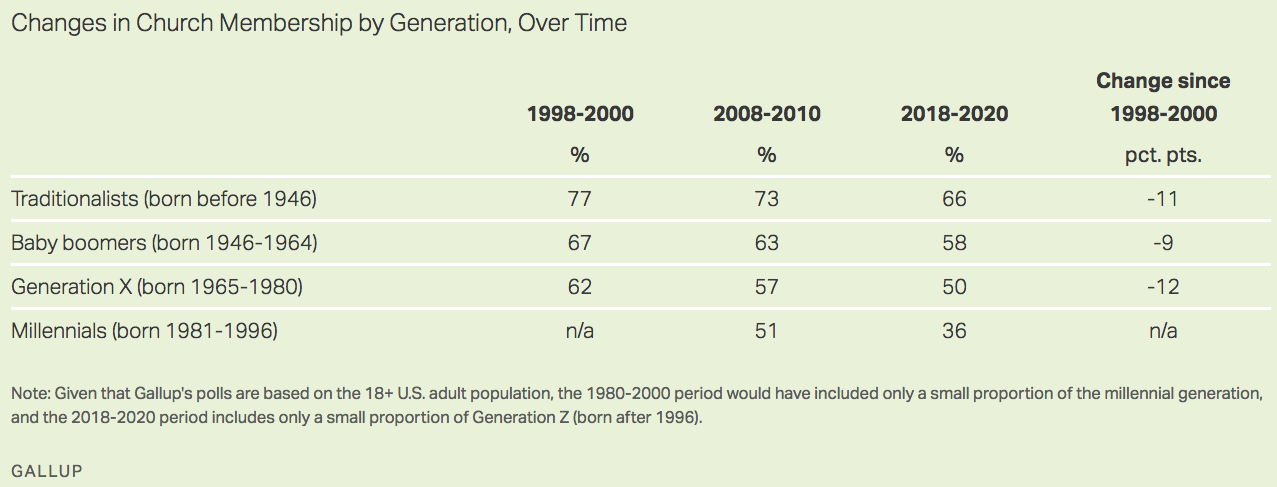
The framework consists of this: (1) people who identity as Christians are decreasing (83% to 71% over last 25 years, (2) the average size church in America is decreasing (the median church size which was 137 people in 2000 has dropped to 60-65 people today, which means that over the last 25 years, the average church size in America has been more than cut in half), and (3) overall church membership is decreasing as well as the number of times/month that people typically attend a church even if they are a member.
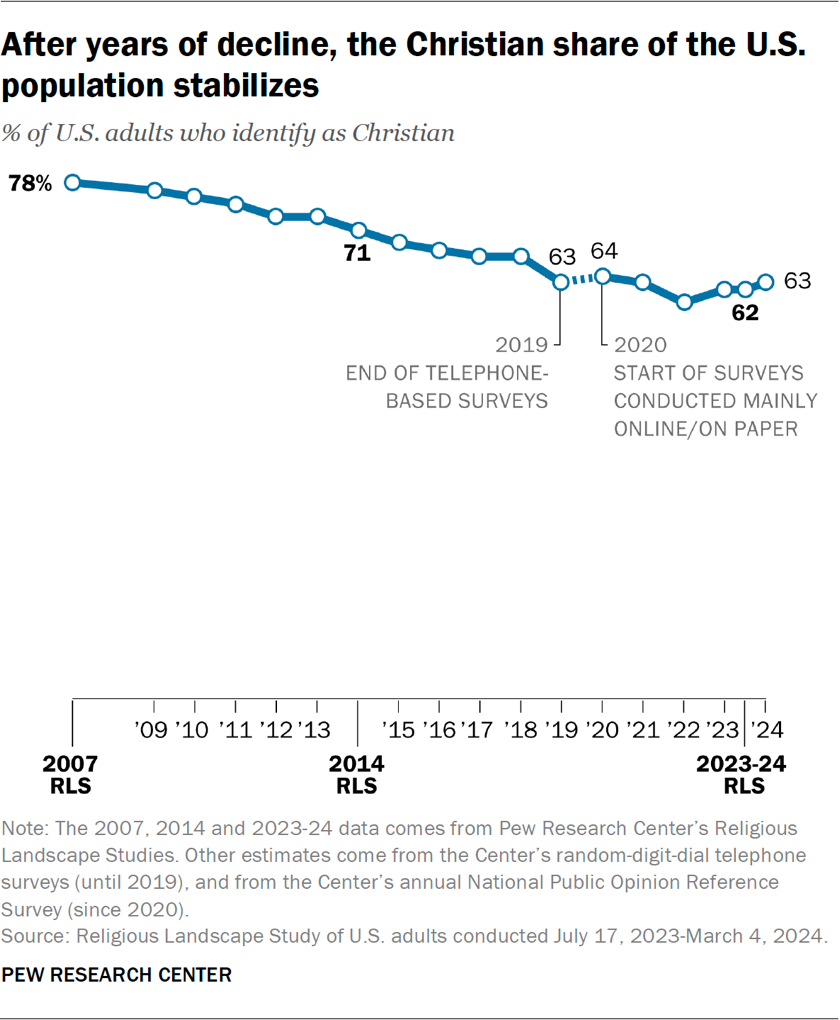
Working with another set of data, the Religious Landscape Study (RLS), indicated a 15% decline of US adults who identity as Christian from 78% (in 2007) to 63% (in 2024) though there has been a stabilization of the decline over the last 5 years. To put this decline in perspective, 15% of the US population (of 330-340 million) equates to nearly 49.5 to 52 million people who no longer identity as Christian. This decline represents a massive down-turn of Christian identity in America over the last two decades!
Second, Ryan Burge’s article entitled “Perspective: What the data really says about religious revival and Gen Z: the reversal of a trend would require a transformation unlike anything we’ve seen in modern times” also serves to pump the brakes on the hopeful optimism for revival in America. Burge argues that the narrative of a massive return to church is not born out by actual statistics:
“It seems that a large segment of the American public is eager for any sign that the rise of the nones is over and that churches might begin to fill back up in the years to come…. As the share of adults with no religious affiliation climbed from just 6% in 1991 to nearly 30% in 2020, it would certainly make headlines if that march toward secularism suddenly stopped — and even more so if the ones leading a return to church were teens and 20-somethings.”
Burge argues that anecdotal narratives have often replaced actual statistics amongst mainstream media outlets.

Burge makes much of the idea of “generational replacement”, arguing that “every day, older Americans die and are replaced by young adults turning 18. This process unfolds slowly — almost imperceptibly — in the short term, but over five or 10 years, it can produce profound shifts in the overall landscape.” Burge is making a case which is pretty easy to understand: older adult Christians are dying and are not being replaced in the church at the same rate as those entering adulthood at age 18.
When you compare generations, the pattern is obvious. The youngest members of the Silent Generation were born in the early 1940s, and just 7% report no religious affiliation. In less than a decade, they — and a growing share of Baby Boomers (18% unaffiliated) — will disappear from survey samples.
Meanwhile, millennials are moving solidly into middle age, and 36% of them say they have no religion. Generation Z, all of whom will soon be adults, are even less religious: 43% are nones. That’s 25 points higher than the Boomers they’re replacing. So if the overall share of nones sits around 28% now, it will inevitably rise as generational turnover continues.
Third, Burge argues that even singular cultural events have not typically sustained any measurable rise in religious attendance in the United States over the last quarter century. Many remember the churches filling up after the terrorist attacks of Sept 11, 2001 only to quickly return to normal. “Likewise, the Asbury University revival of February 2023 received wall-to-wall media coverage, but follow-up reporting showed no lasting change in local religiosity a year later.”
Thus, whereas talk of a full-scale “revival in America” seem to be overblown, there are nonetheless some encouraging signs amidst the overall institutional decline of the church in America:
48% of Gen Zers and 44% of Millennials recently responded “Yes” to the idea: “I am open to Jesus, but do not consider myself a Christian today.” There seems to be a general openness to authentic ways of living for, and talking about, the way of Jesus amongst the younger generations.
Bible sales were up 11% in 2025 compared to 2024.
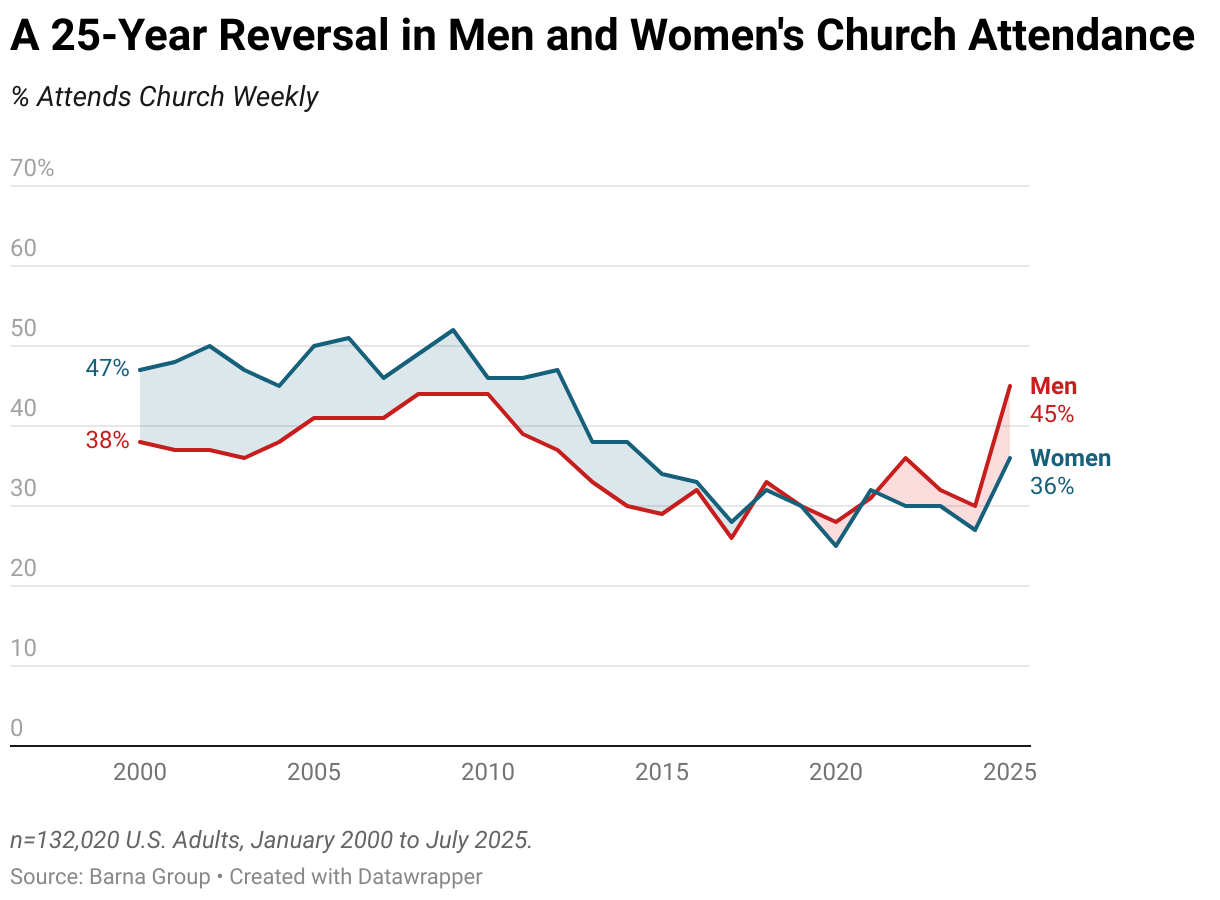
Reversing a decades-long trend, men (45%) are now significantly outpacing women (36%) in church attendance with married fathers taking the lead in going to church. Whether this is a net positive (where did all the women go?) over the long-haul remains to be seen, but the hope would be that as fathers take the lead in church attendance, the entire family might follow dad to church in the future.
The Rise of the Nones. Institutional church decline. Declining church attendance. None of these phrases sound overly hopeful for the future of the church in America. Yet these statistics themselves need to be set within the God-centered universe that the scriptures declare is our reality. Two scriptural phrases come to mind which help put these gloomy statistics in their proper place.

“But God.” Ephesians 2 begins with terrible news: we were dead in our trespasses and sins (vs. 1). We were walking under the influence of the world and following the power of the devil (vs. 2), simply living for the passions of our flesh (vs. 3). No dystopian movie ever produced could give a bleaker, blacker, and more dismal view of our situation than when Paul says that we “were by nature children of wrath” (vs. 3). That’s personally cataclysmic on an eternal scale! But then Paul reaches for the great phrase – BUT GOD.
But God, being rich in mercy, because of the great love with which he loved us, even when we were dead in our trespasses, made us alive together with Christ – by grace you have been saved. Ephesians 2:4-5.
Church trends are nothing compared to the great “But God” of his saving power.
The second scriptural phrase that seems apropos to remember in this cultural moment occurs in Matthew 19. The disciples are incredulous at Jesus. The bar of salvation seems too high to climb for the disciples. The disciples were “astonished” and began saying, “Who then can be saved?” (vs. 25). Jesus was telling his disciples, “Again, I tell you, it is easier for a camel to go through the eye of a needle than for a rich person to enter the kingdom of God.” (vs. 24). Within the worldview of first-century Judaism, great wealth was often simplistically equated with great spiritual blessings from God. If the wealthy were only saved – with enormous difficulty – what hope was there for everyone else? That’s when Jesus reminded his disciples of the Lord’s great power to save: “With man this is impossible, but with God all things are possible.” (vs. 26). Yes, there it is! With God all things are possible.

No matter how dark the culture or how toxic the politics or how declining the church, believers would be wise to remember: With God all things are possible. The possibility of revival is always over the next hill and horizon. God is always free to move with great saving power, bringing his beloved children into his church.
Jesus Christ is, after all, the Head of the Church. I trust that the Great Shepherd of the Sheep (Heb. 13:20) will always pastor us with grace and love whatever season the church is in: whether in retreat or advance, whether in revival or decline. God is still on the throne, whatever the trends say and whatever the culture decries.
With God all things are possible.
Soli Deo Gloria.