Church: A Training and Equipping Station

In a recent sermon, I indicated my hope for Trinity Wellsprings Church over the next five years: that our church would increasingly become a central hub of training and equipping. Here’s the vision simply stated:
People increasingly come to our campus to get Trained & Equipped for life-giving ministry, and our vision for deep discipleship is increasingly coupled with a telos (purpose/goal) that places people on a pathway for ministry, whether that ministry is serving sacrificially in the church or being “salt” and “light” (Mt. 5:13-16) in the neighborhood, workplace, and community.
On the Main Campus: we focus on studying and applying the Word of God to our lives– not only to grow in the faith but also to become an instrument in the hands of the Redeemer and a channel of grace and blessing to those around us. On campus, we worship together, we pray together, we sit under the preached Word of God, we experience a surplus of joy and love as we fellowship together. Our lives are changed by experiencing the simple rhythms of grace – worship, prayer, scripture, relationship – all focused on Jesus.
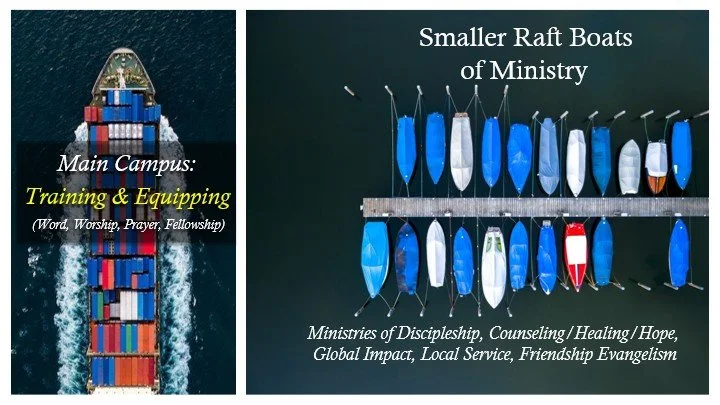
What eventually happens in the training and equipping station? Little life-boats of ministry get launched out for ministry!
As people experience the “deep discipleship” of Jesus at Trinity – they are filled up with worship, prayer, community, and the scriptures – we are increasingly sent out as ambassadors of the gospel. People increasingly sense a confidence that they have been trained and equipped for life-on-life gospel ministry. People are sent out as ambassadors of biblical counsel, ambassadors of global impact and local service, ambassadors of outreach and friendship evangelism, ambassadors of reading the Bible one-on-one with people far from God, and ambassadors of healing and hope. YOU become one of the many life-boats of ministry launching out from the mother ship of Trinity.
I believe this is the pattern we see in the life and ministry of Jesus. Jesus did not teach the Word of God for his disciples’ heads simple to swell up with more and more knowledge (a bloated-head kind of discipleship). The goal of Jesus’ ministry was not to draw big crowds that never went out to proclaim the hope and grace of the Kingdom of God (a consumer-based, entertainment-style ministry).
In Matthew 4:19, Jesus is walking by the Sea of Galilee, and he gives a paradigmatic discipleship call which rings true for all believers in every church, in every culture, and in every generation (not only for Simon Peter and his brother Andrew in the first century): “Follow me, and I will make you fishers of men.”
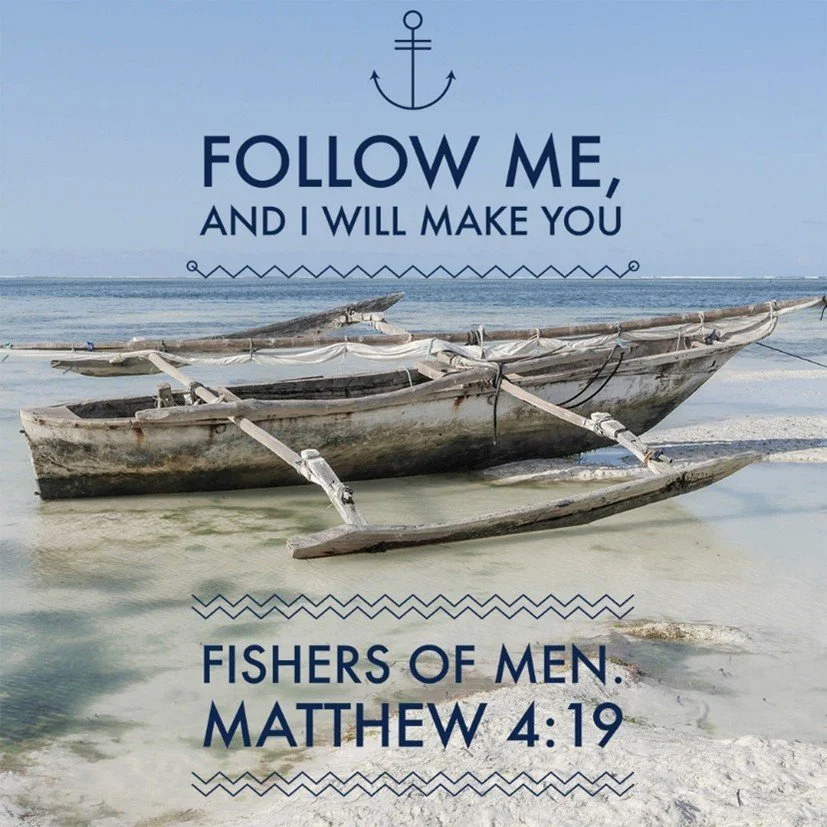
The paradigmatic discipleship call of Jesus entails two great ends:
1) Follow Jesus. The disciples were to keep close to Jesus by observing his rhythms and habits of life. They learned how to live in the Kingdom of God by applying the scriptures to their lives (Matt 5-7). They sought to embrace a life of prayer (“Lord, teach us to pray,” Luke 11:1). From the early church, we understand that the disciples learned from Jesus great compassion and love for the lost (Acts 2:38-41; 3:1-10; 9:32-43; 20:18-21) and cared for the poor and the widows in remarkable ways (Acts 4:32-35; 6:1-6).
2) Become Fishers of Men. The disciples were to live a life of ministry. Their discipleship had a telos. In educational circles we would say that their discipleship education produced the learning outcome of a life of ministry. In business circles, we would say that they re-invested the profits (of discipleship) back into the business to strengthen it and to promote its future growth. Becoming fishers of men was built into the very fabric of being a disciple by Jesus. Becoming a “fisher of men” was the understood and necessary by-product of agreeing to apprentice under Jesus the Messiah.
May our church be stamped profoundly by the call of Jesus: deep discipleship (“Follow me”) paired with life-on-life ministry (“and I will make you fishers of men”).